
Why Calling a Chatbot “AI Support” Damages Trust and Compliance
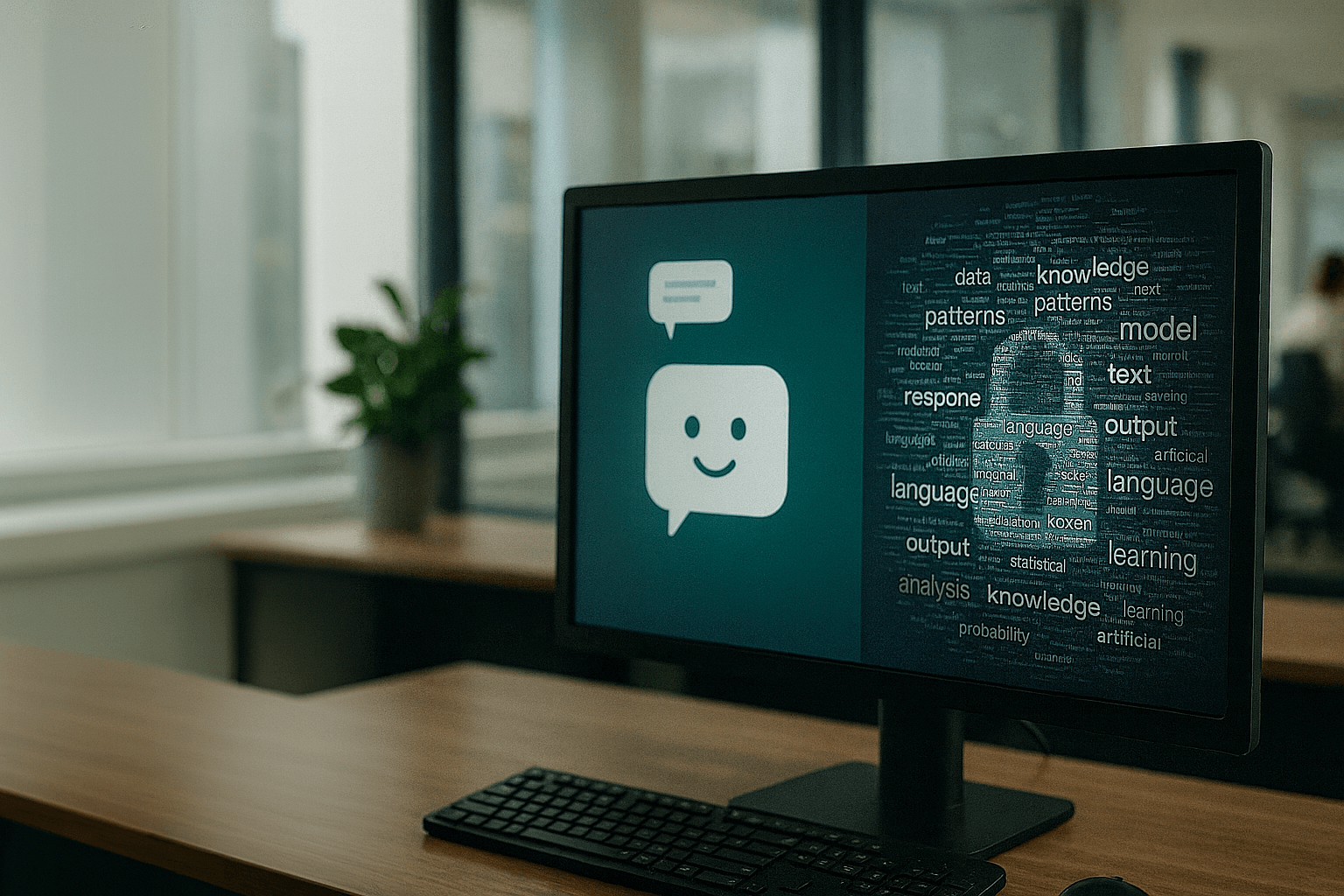
The chatbot illusion
You’ve probably seen it: a website pop-up proudly announcing “Chat with our AI support agent!” The first few messages sound intelligent enough — until you realise it can’t escalate your ticket, misreads your tone, or loops endlessly on a billing question.
That’s not artificial intelligence. That’s an LLM-powered assistant doing its best to sound human.
The difference may seem trivial, but it defines how you govern customer data, manage liability, and shape user expectations.
If a system can’t understand context, hold goals, or act on behalf of your company, it isn’t an AI support agent. It’s a scripted or generative assistant — and that matters.
What real AI support would look like
A genuine AI helpdesk system would need to do far more than chat. It would need to:
- Interpret intent and route tasks dynamically.
- Execute actions across systems — refunding payments, updating records, assigning technicians.
- Adapt from feedback (learning that customers prefer certain resolutions).
- Act autonomously within defined limits and policies.
That requires a full perception → reasoning → action → learning loop — the traditional definition of artificial intelligence.
Very few commercial “AI chatbots” can do that. Most are built around LLMs that only simulate understanding.
What most businesses actually deploy
Most helpdesks labelled “AI” are in fact LLM-integrated interfaces wrapped around a knowledge base.
They:
- Read existing FAQs.
- Predict the next plausible sentence to sound helpful.
- Generate empathetic language, not real solutions.
These are linguistic engines, not decision systems. Their function is text generation, not action.
The danger begins when organisations forget this — and start allowing these systems to handle sensitive user data or make binding promises.
Helpdesk contrast: “AI Support Agent” vs “LLM Helpdesk Assistant”
The AI Support Agent (what customers are promised)
Imagine a company advertises a 24/7 “AI Support Agent” capable of resolving billing, technical, and account issues.
If that were true, it would:
- Have direct access to your billing and CRM systems.
- Make changes on your behalf.
- Learn from repeated interactions.
- Operate under accountability rules similar to a human agent.
In compliance terms, this agent:
- Is processing personal data autonomously.
- Must meet data protection and audit requirements.
- Requires clear accountability trails for every decision made.
Now contrast that with what most firms actually deploy.
The LLM Helpdesk Assistant (what you really have)
The LLM version:
- Retrieves potential answers from the knowledge base.
- Generates human-like responses to clarify questions.
- Escalates the ticket to a real agent when it’s uncertain.
It doesn’t decide. It assists.
That places it outside the regulatory scope of autonomous AI systems and keeps accountability with the human operator or customer service process owner.
Key compliance difference: The LLM assistant provides text suggestions; the AI agent performs actions. Only one of them can create regulatory exposure if it fails.
The data-handling trap
When customers see “AI support”, they naturally assume the system is authorised to handle personal data. They might share card numbers, ID numbers, or confidential account details, believing the “AI” is part of the secure backend.
But most LLMs:
- Operate through external inference APIs.
- Log interactions for quality improvement.
- Do not guarantee data isolation unless specifically configured.
Calling such a system “AI support” implies security that may not exist — a data governance red flag.
User trust and expectation management
Language shapes expectation. If a customer believes they are speaking to AI, they will:
- Expect instant resolution.
- Assume the system remembers them.
- Hold the company responsible for any incorrect answer.
When they later discover that it was “just a bot”, trust erodes. The fix isn’t better hype; it’s clear, precise labelling.
Use:
- “Automated assistant” or
- “Chat support bot powered by our knowledge base”
This communicates value without over-promising intelligence.
Internal consequences of the AI label
Inside the organisation, mislabelling has other side effects:
| Area | If you call it “AI Support” | If you call it “LLM Assistant” |
|---|---|---|
| Governance | Requires AI governance framework, risk classification, and bias audits | Standard software governance with prompt testing |
| Customer expectations | Expects self-resolution and accountability | Expects guidance and escalation |
| Data handling | May imply internal data access and secure storage | Limited to pre-approved prompt contexts |
| Support workflow | Risk of over-automation and missed human review | Clear human escalation path |
| Brand risk | Trust damage when “AI” fails | Transparency and consistent experience |
The takeaway is clear: Language determines oversight. Once you claim “AI”, you assume AI-level responsibility.
Between the lines: the performance theatre
The reason this mislabelling persists is emotional, not technical. “AI” signals innovation and capability; “LLM chatbot” sounds dull. Yet the latter is what delivers consistent customer experience — because it’s predictable, monitored, and governed.
What companies really sell with “AI helpdesk” is confidence theatre: a fluent front end that performs intelligence while relying on human operators behind the curtain.
Honest language helps you escape that theatre and build durable trust.
Further thoughts…
Before you call your chatbot “AI support”, ask yourself:
- Does it act autonomously or assist humans?
- Does it make decisions or draft replies?
- Would you trust it with legal accountability?
If the answer is “no”, then you have an LLM-powered helpdesk assistant, not an AI agent — and that’s perfectly fine. Clarity protects your users, your compliance posture, and your brand reputation.
Final thought: Customers don’t need an “AI agent”. They need fast, accurate help. Honesty about what powers your support experience is the real intelligence.