
What Reverse MX Reveals About Your Email Attack Surface
Email remains one of the most abused entry points into corporate environments. Phishing, brand impersonation, account takeover, and fraud campaigns continue to rely on one consistent technical layer: mail server infrastructure. While most security teams focus on domains, URLs, and IP reputation in isolation, attackers organise their operations around shared infrastructure.
This is where Reverse MX lookups matter.
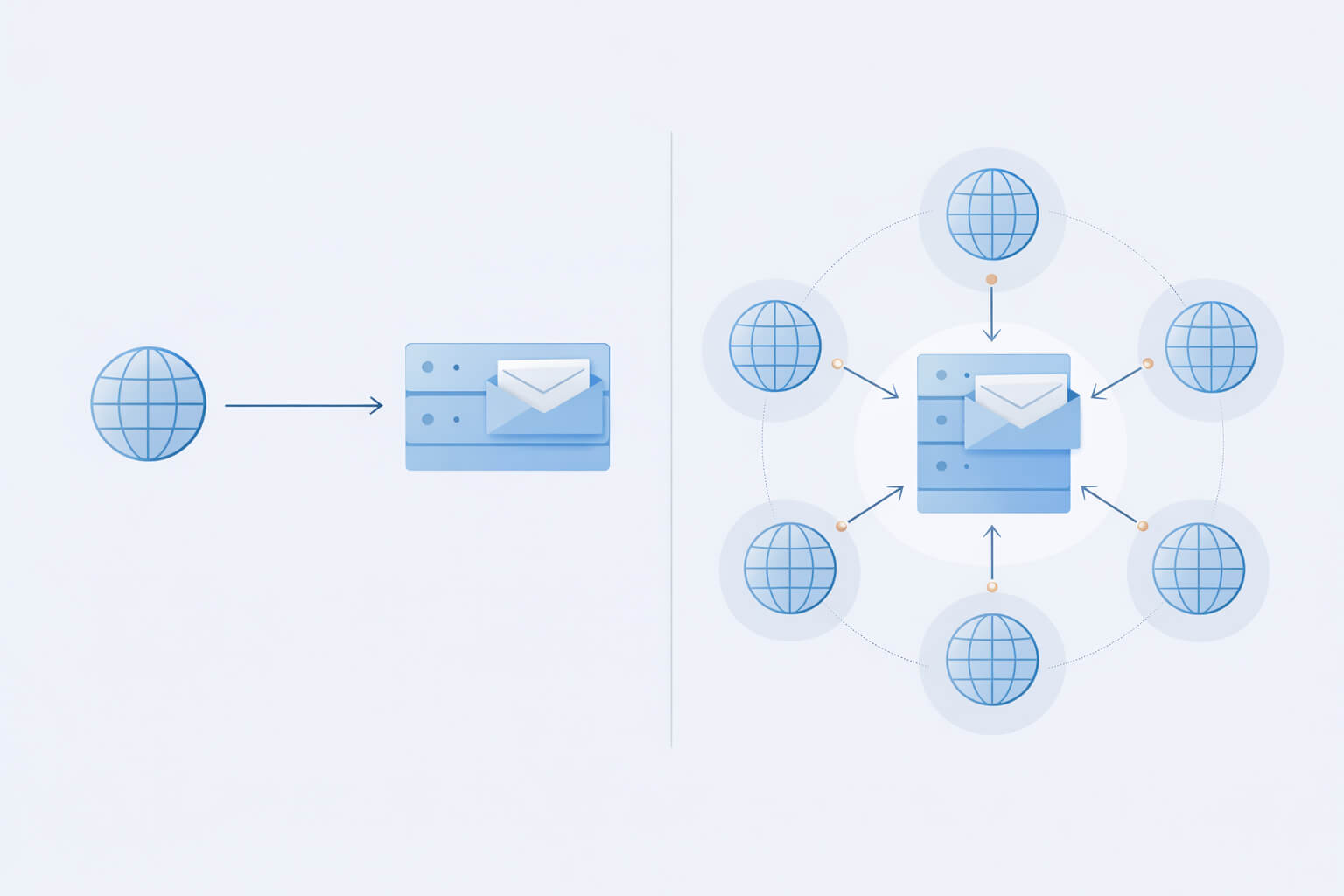
A standard MX lookup answers a simple question: which mail server handles email for this domain? A Reverse MX lookup inverts that view: which domains rely on this mail server?
That reversal changes how defenders see email risk. Instead of responding to individual domains one by one, security teams can observe clusters of related domains, identify hidden or forgotten assets, and link apparently unrelated incidents back to a shared origin.
This article focuses on three practical security use cases where Reverse MX provides direct operational value. Each use case is grounded in real security workflows rather than theory, and avoids overstating what the technique can or cannot do.
What Reverse MX Is (and what it is not)
Reverse MX is a correlation technique, not a detection system on its own.
It works by querying datasets that map mail exchangers to the domains that reference them. The result is a list of domains that depend on the same email delivery infrastructure. On its own, that list is just data. Its value comes from contextual analysis:
- ownership
- registration timing
- domain structure
- reputation history
- association with known incidents
Reverse MX does not:
- detect malware
- block phishing by itself
- replace email gateways or SIEM platforms
It does:
- expose relationships that traditional domain-centric analysis misses
- reduce blind spots in email asset visibility
- support faster scoping during incidents
Use case 1: Email attack surface discovery and asset control
The problem security teams face
Most organisations cannot produce a definitive list of all domains that send or receive email on their behalf. Over time, domains accumulate:
- legacy project domains
- regional or campaign domains
- domains registered by former suppliers
- typo variants created defensively or forgotten
These domains may still point to active mail servers. That creates risk without visibility.
Unknown domains can:
- receive sensitive email unintentionally
- be taken over if registration lapses
- be abused for impersonation without triggering alerts
Traditional asset inventories rarely cover this layer.
How Reverse MX applies
The starting point is not the domain, but the mail server.
- Identify the organisation’s legitimate inbound mail exchangers.
- Perform a Reverse MX lookup against each server.
- Compare the returned domain list against the approved domain inventory.
- Flag anything that does not belong.
This approach exposes:
- forgotten domains still routing email
- misconfigured third-party domains
- look-alike domains quietly attached to the same infrastructure
Why this matters operationally
From a security perspective, unknown assets create exposure without accountability.
Reverse MX enables teams to:
- bring shadow domains back under ownership review
- remove stale MX records
- separate unrelated domains onto different infrastructure
- support brand protection efforts with concrete data
This technique fits naturally into attack surface management processes. It is not a replacement for DNS monitoring or certificate transparency, but it closes a specific gap around email routing that those tools often miss.
Practical limitations
- Large hosted mail platforms return very large result sets.
- Shared hosting environments require careful filtering.
- Reverse MX data should be cross-checked against WHOIS, DNS history, and registration dates.
Used carefully, this becomes a recurring hygiene task rather than a one-off audit.
Use case 2: Infrastructure correlation during phishing investigations
The problem security teams face
Most phishing response workflows are reactive:
- a domain is reported
- the domain is blocked
- the incident is closed
This treats each phishing domain as an isolated event. In reality, attackers operate domain pools supported by shared mail servers, templates, and registration patterns. Blocking a single domain rarely stops the campaign.
How Reverse MX applies
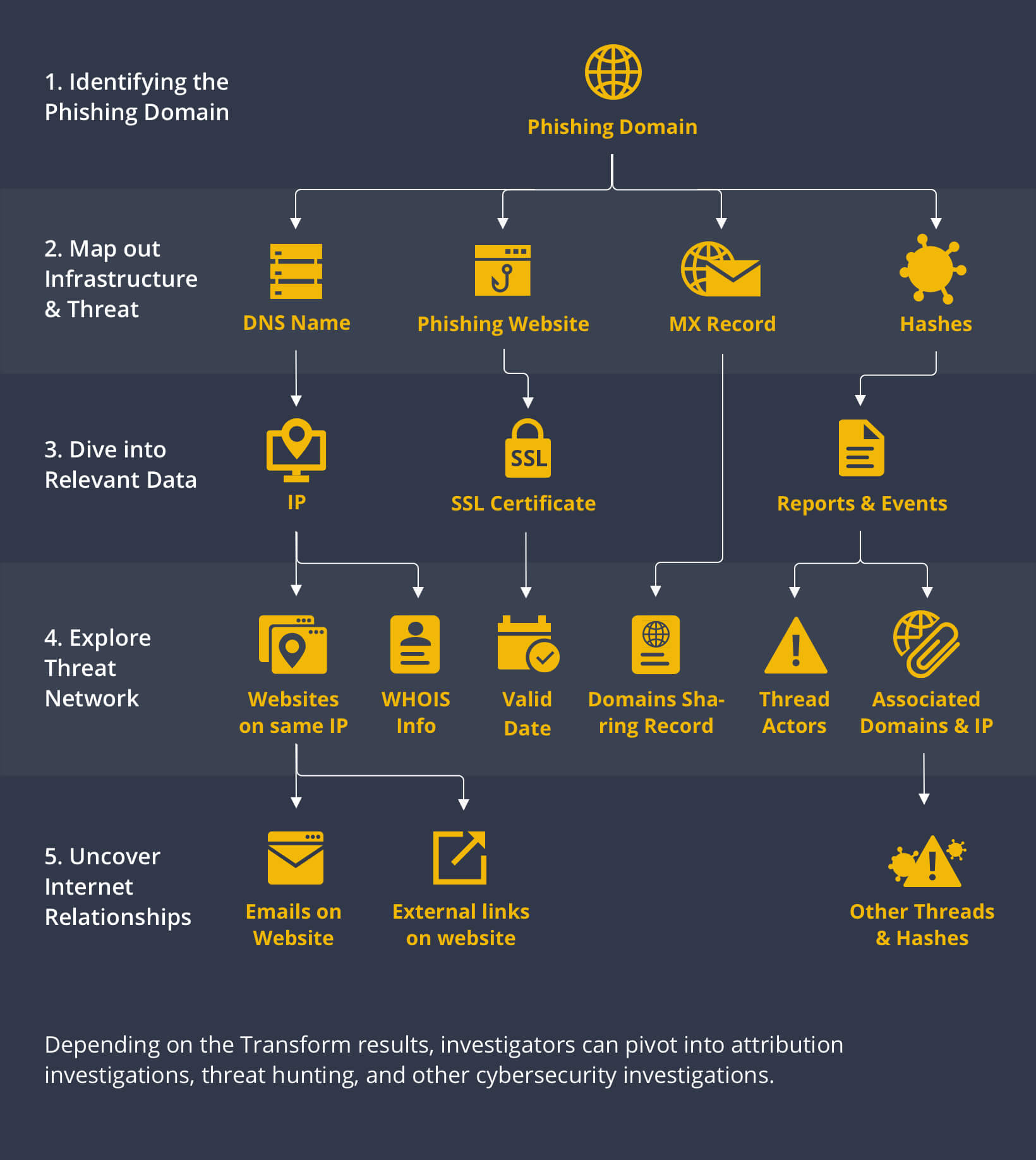
When a phishing domain is identified:
- Extract its MX record.
- Perform a Reverse MX lookup on that mail server.
Review the associated domains for shared traits:
- registration timeframes
- naming structure
- hosting overlap
- Expand indicators beyond the original domain.
Instead of one IOC, defenders obtain a cluster of related infrastructure.
Why this matters operationally
Correlation allows incident response teams to:
- scope the campaign more accurately
- block multiple domains at once
- brief stakeholders with clearer impact assessments
- feed higher-quality indicators into threat intelligence platforms
This is especially useful against:
- phishing frameworks reused across campaigns
- affiliate-based phishing operations
- fraud campaigns that rotate domains frequently
Reverse MX does not attribute attackers. It reduces guesswork by showing which domains are technically connected, allowing analysts to prioritise investigation effort where it counts.
Practical limitations
- Shared mail servers can host both benign and malicious domains.
- Correlation does not imply intent; it indicates association.
- Results must be reviewed alongside email telemetry and user reports.
Used correctly, Reverse MX supports decision-making, rather than replacing analyst judgement.
Use case 3: Monitoring phishing infrastructure expansion
The problem security teams face
Large phishing operations scale quickly. Domains appear, disappear, and reappear across short timeframes. By the time a campaign is visible to end users, much of the infrastructure is already in place.
Defenders are often reacting after delivery has begun.
How Reverse MX applies
Rather than waiting for a phishing email to arrive, teams can monitor known malicious mail servers or previously observed infrastructure.
A practical workflow looks like this:
- Maintain a list of mail servers previously linked to phishing activity.
- Run scheduled Reverse MX lookups against those servers.
- Track newly observed domains over time.
Apply risk scoring based on:
- registration age
- domain entropy
- known brand patterns
- pre-emptively block or monitor high-risk domains.
This shifts focus from individual messages to infrastructure growth.
Why this matters operationally
This approach supports:
- earlier detection of campaign preparation
- reduced dependency on user reporting
- better prioritisation of blocking actions
- tighter coordination between email security and threat intelligence teams
It does not prevent phishing on its own, but it buys time. That time matters when campaigns target payroll, finance, or executive impersonation.
Practical limitations
- Not all attackers reuse mail servers.
- False positives are possible without context.
- Monitoring scope should be limited to known high-risk infrastructure.
Reverse MX is most effective here when paired with domain reputation scoring and email gateway telemetry.
Compliance and internal misuse: setting realistic expectations
Reverse MX can support audit and investigation work, but it should not be presented as a compliance control.
Used appropriately, it can:
- demonstrate visibility over email routing assets
- support evidence gathering during audits
- assist post-incident reviews involving email misuse
It should not be positioned as:
- a standalone compliance mechanism
- a primary insider threat detection tool
Security value comes from supporting evidence, not automated judgement.
Implementation considerations
When integrating Reverse MX into security workflows, teams should plan for:
- Filtering logic to separate shared hosting noise from risk
- Rate limits and query costs when running scheduled lookups
- Data handling controls for stored domain and registration data
- Clear ownership for reviewing and acting on results
Most organisations start by using Reverse MX during investigations, then gradually introduce scheduled monitoring for known risk infrastructure.
Further notes
Reverse MX changes how email risk is viewed. It replaces a narrow, domain-by-domain perspective with an infrastructure-centric one that aligns more closely with how attackers operate.
Used carefully, it helps security teams:
- reduce blind spots in email asset visibility
- respond to phishing incidents with better context
- understand infrastructure reuse across campaigns
It is not a silver bullet. It is a supporting technique that becomes valuable when combined with existing detection, investigation, and response processes.
For teams already managing email security seriously, Reverse MX is worth adding to the toolbox — not as a novelty, but as a methodical way to see relationships that would otherwise remain hidden.